Ghana Waste & Medical Waste Incinerator Market Report
Market-Driven Insights from Accra, Kumasi, Tema, Takoradi, Tamale
1. Ghana context: why incineration remains structurally relevant
Ghana is one of West Africa’s most institutionally active and internationally connected countries. Rapid urbanization, expanding healthcare coverage, and growing industrial and port activity have significantly increased pressure on medical waste and sensitive solid waste management.
Waste generation and institutional demand are concentrated in:
-
Accra – capital city, national hospitals, ministries, UN and NGO headquarters
-
Kumasi – major inland metropolis with teaching hospitals and laboratories
-
Tema – port city with industrial zones, logistics facilities, and clinics
-
Takoradi – oil, gas, and port-related activities
-
Tamale – northern regional hub with hospitals and humanitarian operations
In Ghana, incineration is widely viewed as a controlled treatment solution for waste streams that cannot be safely landfilled or recycled, particularly medical, pharmaceutical, and institutional waste.
2. Structural characteristics of the Ghana incinerator market
A. Healthcare waste as the anchor segment
The most consistent demand comes from:
-
public and private hospitals,
-
laboratories and diagnostic centers,
-
vaccination and disease-control programs.
Ghana’s expanding healthcare network has made on-site medical waste incineration a standard requirement, especially in projects supported by international partners.
B. Urban–regional contrast
While Accra and Kumasi require higher-capacity and more regulated systems, many regional facilities prefer compact, decentralized solutions. This creates strong demand for modular and mobile incinerators.
C. Infrastructure variability
Power reliability varies by region. As a result, diesel-fired incinerators with autonomous operation remain highly attractive across Ghana.
3. City-based demand analysis
Accra – National healthcare and institutional core
Accra hosts national referral hospitals, research laboratories, ministries, and international organizations. Incinerators here are mainly used for:
-
infectious medical waste,
-
pharmaceutical destruction,
-
secure disposal of institutional waste.
Projects linked to international frameworks often specify dual-chamber incinerators with documented operating parameters and operator training.
Kumasi – Teaching hospitals and regional services
As a major educational and medical center, Kumasi generates continuous healthcare waste. Top-loading incinerators are favored due to:
-
simple operation,
-
tolerance of mixed bagged waste,
-
reduced dependence on advanced infrastructure.
Tema & Takoradi – Ports, industry, and logistics
In Tema and Takoradi, waste streams include medical waste from port clinics, contaminated packaging, and institutional waste. Containerized incinerators are attractive because they:
-
minimize civil works,
-
integrate easily into industrial compounds,
-
allow relocation as port layouts evolve.
Tamale – Regional and humanitarian demand
Tamale serves northern Ghana and often supports NGO and UN-related programs. Mobile and containerized incinerators are well suited for this decentralized and project-based demand.
4. Role of the United Nations and international institutions
In Ghana, United Nations agencies and international NGOs play a strong normative role in waste management projects.
Their involvement influences:
-
technical specifications,
-
procurement procedures,
-
training and documentation standards.
Programs aligned with UNDP, WHO, UNICEF, and other UN frameworks emphasize:
-
safe destruction of infectious waste,
-
operator safety,
-
reliable, well-documented equipment rather than experimental technology.
5. Market demand trends in Ghana
-
Medical waste incineration remains the most stable growth segment, especially in urban centers.
-
Containerized and mobile incinerators are increasingly requested for regional hospitals and project-based installations.
-
Buyers value modular systems that can be expanded or relocated as demand grows.
-
Emission control requirements are rising but remain practical and project-specific.
6. Product–market fit: HICLOVER solutions for Ghana
HICLOVER incinerators match Ghana’s operational and institutional environment, particularly through mobile, containerized, and modular designs:
-
Medical waste incinerators for hospitals and laboratories
Suitable for Accra, Kumasi, and Tamale healthcare networks.
→ Medical Waste Incinerator Systems
https://www.hiclover.com/medical-waste-incinerator/ -
Top-loading incinerators for mixed medical and institutional waste
Effective where waste segregation is limited and batch operation is preferred.
→ Top-Loading Waste Incinerators
https://www.hiclover.com/top-loading-incinerator/ -
Containerized mobile incinerators (key advantage for Ghana)
Designed for rapid deployment in Tema, Takoradi, and regional cities with minimal site preparation.
→ Containerized Mobile Incinerators
https://www.hiclover.com/containerized-mobile-incinerators/ -
Optional modular flue-gas treatment systems
Applied selectively in dense urban areas or donor-sensitive projects.
→ Incinerator with Wet Scrubber System
https://www.hiclover.com/incinerator-with-1-or-3-section-type-wet-scrubber/
Key advantage in Ghana:
HICLOVER emphasizes containerized mobility, modular expansion, diesel compatibility, and compliance-ready design, supporting both large urban hospitals and decentralized regional facilities.
7. Strategic theme highlight: “Modular incineration for a growing healthcare system”
A compelling Ghana-specific positioning theme is:
“Mobile and modular incineration for a rapidly expanding healthcare network.”
This reflects Ghana’s real procurement logic:
-
healthcare infrastructure is expanding,
-
budgets are phased,
-
flexibility and reliability matter more than permanent civil works.
It resonates with hospital administrators in Accra, project managers in Kumasi, and international partners operating across Ghana.
Résumé en français (bref)
Au Ghana, l’incinération joue un rôle clé dans la gestion des déchets médicaux et des déchets solides sensibles, notamment à Accra, Kumasi, Tema, Takoradi et Tamale. Les Nations Unies et les ONG internationales influencent fortement les normes et les pratiques. Les solutions mobiles, containerisées et modulaires sont de plus en plus recherchées pour accompagner l’expansion du système de santé. Les incinérateurs HICLOVER sont bien adaptés aux réalités opérationnelles et institutionnelles du marché ghanéen.
2025-12-13/22:40:03
|
Incinerator Items/Model |
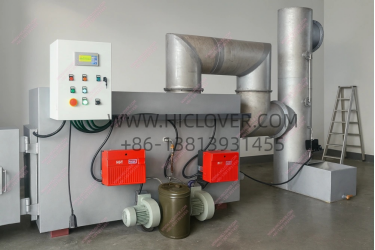
HICLOVER TS100(PLC)
|
|
Burn Rate (Average) |
100kg/hour |
|
Feed Capacity(Average) |
150kg/feeding |
|
Control Mode |
PLC Automatic |
|
Intelligent Sensor |
Continuously Feeding with Worker Protection |
|
High Temperature Retention(HTR) |
Yes (Adjustable) |
|
Intelligent Save Fuel Function |
Yes |
|
Primary Combustion Chamber |
1200Liters(1.2m3) |
|
Internal Dimensions |
120x100x100cm |
|
Secondary Chamber |
600L |
|
Smoke Filter Chamber |
Yes |
|
Feed Mode |
Manual |
|
Burner Type |
Italy Brand |
|
Temperature Monitor |
Yes |
|
Temperature Thermometer |
Corundum Probe Tube, 1400℃Rate. |
|
Temperature Protection |
Yes |
|
Automatic Cooling |
Yes |
|
Automatic False Alarm |
Yes |
|
Automatic Protection Operator(APO) |
Yes |
|
Time Setting |
Yes |
|
Progress Display Bar |
3.7 in” LCD Screen |
|
Oil Tank |
200L |
|
Chimney Type |
Stainless Steel 304 |
|
1st. Chamber Temperature |
800℃–1000℃ |
|
2nd. Chamber Temperature |
1000℃-1300℃ |
|
Residency Time |
2.0 Sec. |
|
Gross Weight |
7000kg |
|
External Dimensions |
270x170x190cm(Incinerator Main Body) |
|
Burner operation |
Automatic On/Off |
|
Optional |
|
|
Wet Scrubber |
Optional |
|
Optional |
|
|
Asbestos Mercury Material |
None |
|
Heat Heart Technology(HHT) |
Optional |
|
Optional |
|
|
Dual Control Mode(Manual/Automatic) |
Optional |
|
Temperature Record |
Optional |
|
Enhanced Temperature Thermometer |
Optional |
|
Incinerator Operator PPE Kits |
Optional |
|
Backup Spare Parts Kits |
Optional |
|
Optional:Containerized/Trailer/Sledge Optional |
Comments are closed